Dog

Dog
Showing posts with label Famous Artists. Show all posts

Friday, 23 March 2018

Creativity Challenge - Week 12

"Emily's Tree, Doncaster Park, Ste.- Adèle", inspired by Emily Carr
Blog 12


Thank you for reading my blog. If you have followed my blogs over the last couple of weeks you know that we are preparing our house for sale. Despite all the decluttering and packing, I was still able to be creative almost every day. This week, however, with the painter painting most of the rooms in our house, the house was in chaos; furniture was standing everywhere. To avoid having to pack twice, I tried to stay on top of putting it all in boxes until late in the evening. Some nights, I went straight to bed, while on other nights I just managed to add a couple of rows to my temperature shawl.

Saturday afternoon, I actually went into my studio for an hour because the tulips that I had bought were luring me in with their beauty. I hope that I will manage to finish the painting by next week.

I also sat down to finish some teddy bear figurines that will be part of a game, similar to “Don’t Worry”. They have not been touched for far too long because other things were more exciting. Right now, sewing the heads to the bodies seems like the perfect relaxing project. At this point, it is not very creative but exactly what my restless hands need while watching TV.

So where do I go from here? The next couple of weeks will probably still be very exhausting. I could just give up under the pretense that I am just too busy before we move. Then I could add that I will probably also be too busy once we have moved. There are always reasons to stop, but like with physical activity or healthy eating, the important thing is that you start again where you left off.

As for this week, I wanted to take the opportunity to talk about a subject that always comes up when I am teaching: painting from photos found on the Internet, a calendar, or even copying a painting from another artist.

my version of Emily Carr's "Odds and Ends"
While it is a good learning experience to copy another artist’s .
painting to learn from their techniques, it is important that you see it as a study. It is someone else’s intellectual property. They figured out the composition, the use of colour and texture, and they should be credited for it. When I took several painting courses studying the masters, I took my own photos and created paintings in the style of the studied artist. Later, when I taught the “Painting like Famous Artists” courses, we worked from photos of an original work. These paintings will never be for sale, and I clearly identified the fact that I copied an original on the front of the painting, stating both the original artist and the name of the painting. Even in this case, you can legally only copy a painting that is in the public domain, which means that they are no longer copyrighted

When you take a photographer’s images for reference photos for your own paintings, you will be fine as long as you just keep them in you house. However, the correct approach would be to contact the photographer and ask for permission to use the photo. This is absolutely necessary, if you want to display the artwork in an exhibition. Otherwise, you could get in a lot of trouble for copyright infringement, except if you are using photos that are free to use like material that is in the Public Domain.

I always encourage students to use their own photos as references. It makes a big difference in the energy you bring to your painting, if you have experienced the surroundings. You remember how you felt when you were at the spot, smelled the flowers, or watched a person or pet dear to you.

When I take one of my photos for the first class of my “Acrylic Landscape Painting” course, I do it for two reasons:

1) I do not know if every student would bring a photo.
2) I like to show to them that even when we work from one photo that every one’s finished painting will be different. We are all unique individuals, and this should show in our art. This does not mean that we are not influenced by other artists, but rather that we can incorporate some of their techniques into our own work. However, f ten artists (or students) are painting a subject, you should get ten different works. Your temperament, your mood on any given day, and certainly you skill level will influence your work. That’s why you can even paint the same subject repeatedly, and your painting will not look 100% the same.

To prove the point, here are a couple of set of my paintings from painting parties I lead:


Speaking of painting parties, there are still spaces for the painting party I host on April 15, from 1:30pm to 3:30pm at 1270 Kinsella Drive in Cumberland, ON, K4C 1A9. We will be painting the peonies. The price is $35 per person. The registration deadline is April 8, 2018. The maximum number of participants is 12. For this event, I need at least 8 people and a pre-payment by e-transfer to kpeters@domingoinformatics.ca or cheque payable to Kerstin Peters to reserve a spot.


Friday, 16 June 2017

Famous Animal Paintings

Blog 24

Last week, I wrote about artists who got inspired by animals. This week, I would like to show you some of the famous animal paintings I love.


Marie Cassatt: Sara holding a Cat, via Wikimedia Commons
Not surprisingly, I have fallen in love with Mary Cassatt’s painting “Sara Holding A Cat (1908, oil on canvas)” because it reminds me of my daughter Christine tenderly holding our cat Miko. I love with how much tenderness the little girl holds the tiny kitten. She is totally focused on the cat, taking care of the tiny animal that enjoys her attention as much as she enjoys its.


Franz Marc: Liegender Hund im Schnee, via Wikimedia Commons
Franz Marc’s “Dog lying in the snow (Liegender Hund im Schnee, 1911, oil on canvas)” appeals to me in the same way. It reminds me of our Golden Retriever Jessie as a puppy after we had exhausted her by playing. She loved the snow. I can understand why Marc considered animals purer in soul and more beautiful than human beings. They live in harmony with nature. I love Marc’s use of complementary colours and the calmness of the composition.


Pierre-Auguste Renoir: Le Chat dormant, via Wikimedia Commons
I did not know Auguste Renoir had done animal portraits before I did my research for this blog. I knew that several dogs appeared in his paintings. When I saw “ Le chat dormant” (Sleeping Cat, 1862, oil on canvas) I fell in love with the it right away. Beside that fact that a sleeping cat is very cute, it reminded me of the way our Miko is curled up when he is sleeping.

All three choices are not a surprise because I, like most people, like a painting not only for the skillful execution but mostly for the emotional connection. As a pet owner and mother, I can identify with the subjects of the above mentioned painting. They remind me of situations in my life. Looking at them makes me happy.

The reason behind my appreciation for Frida Kahlo’s “Self-portrait with Monkey” from 1938 is a little bit different. In the painting, the monkey seems to be Frida’s protector as he puts his arm around her neck showing how much he cares for her. It is possible that Frida had all her pets and especially her monkeys because they were a substitute for the children she was not able to have. I love that she seems to be part of the landscape with the green strands of her hair.


When we adopted our first dog Jessie, I had no clue how to treat a dog. We were a young childless couple at that time, and especially at the beginning, I treated her more like a baby than a puppy. I can also relate to the aspect of feeling protected and the unconditional love pets give. As we live in the country where the neighbours are further apart, my dogs have always giving me a feeling of security. I am not sure how real this protection is as I remember our first dog Jessie jumping on my lap when she sensed danger, but I am sure that an intruder or attacker will pick someone without a dog first.

What attracts me to Frida Kahlo’s painting is, however, also the fact that she is one of the artists whose biography I have read and whose strength and resilience I admire. Frida was faced with so much pain in her life, both physical and emotional. It all started when she was left disabled after she contracted polio as a child. In addition, the debilitating physical pain caused by the horrible accident at age 18 left her in very poor health for the rest of her life. Her emotional pain resulted from her husband’s infidelity as well as the fact that she was not able to bear a child even though she was pregnant several times. Nonetheless, she lived her life to the fullest. She used her art to express all the pain she suffered. Her art was a refuge that helped her to deal with the tumults in her life.

I can certainly relate to that. When I am painting, I usually forget all the troubles around me. I am totally immersed in the process of creating. I hope that I will never be tested the way Frida Kahlo was tested in her life, but I know that my ability to express myself in art and to see the beauty in the world around me definitely helps me to process both beautiful and painful events. For me, painting has the same purpose as writing a journal. I hope that my art will help me to find relief, peace and distraction whenever my life is turned upside down. I remember that painting our first dog Jessie after her death was a process accompanied by many tears. At first, I had to put the painting away because the grief was still too strong, but with time painting my beautiful girl helped me to remember her and the joy we had together.

If you enjoyed my blog, please share it. I would like to thank you in advance for helping me to increase my audience.

Friday, 9 June 2017

Artists Inspired by Animals

Blog 23

Since we adopted our first dog in January 1996, our animal companions have not only enriched my life but have also been an inspiration in my creative career. Once we moved into a rural neighbourhood, farm animals and wildlife have been added to the list of animal subject that I have painted.

Animals with their beauty and cuteness, give us a view into a happy life without obligations and regrets. They live for the moment and do not worry about the next day. Paintings and photographs of animals make us remember our own pets, encounters with animals in our life, and our longing for balance in our lives that are often determined by chores and deadlines.

Animals have always fascinated artists. The first cave paintings already showed images of wildlife. However, for a long time animals paintings were not considered serious art because of their lack of creativity even when the were executed with great skill.

When I am thinking of artists who included animals into their artworks, several names come to my mind right away:

George Stubbs: Whistlejacket, via Wikimedia Commons
The English painter George Stubbs is famous for his horse paintings. He is considered one of the best if not the best painter of horses. He paved the way for the acceptance of animal paintings as serious., His painting “Whistlejacket” is a strong example for his mastery.


Albrecht Dürer: Feldhase (Young Hare), via Wikimedia Commons


German artist Albrecht Dürer's studies of animals and plants helped to establish illustrations as fine art. The liveliness of the hare in his painting “A Young Hare” is testimony to the energy and joy Dürer put into the painting.


German painter Franz Marc portrayed many animals in bright primary color, sometimes in a cubist style. He simplified the animals and wanted to express emotion with his use of colours.

Franz Marc: Die kleinen blauen Pferde (The Little Blue Horses), via Wikimedia Commons

Spanish artist Pablo Picasso was a big animal lover and had several animals as pets during his life. The bull is one of the animals that appeared quite often in his art. Often it had symbolic character but Picasso left it to the viewer to interpret his message.

Spanish surrealist painter Salvador Dalí used many animals for their the symbolism in his paintings, among them elephants, ants, butterflies, and locusts.

Mexican painter Frida Kahlo de Rivera did not only live with many animals but also included them in many of her self-portraits. 

Canadian painter Alex Colville had a close relationship with his dogs. He enjoyed their companionship, unquestioned loyalty and love. He saw animals as innocent creatures by nature, that only humans could train to be evil. In his paintings, the animals were either shown as men’s close companions or omens of bad things to come.

Canadian painter Robert Bateman is famous for his realistic paintings of wildlife in its natural surroundings. He is a strong supporter for the protection of nature.

Native artists like Canadian painter Norval Morrisseau express the important role animals play in the lives of aboriginal and first nations people in their paintings. The animals do not only provide food for the people but also have spirits similar to people. The goal of many native artists was to keep the stories and traditions of their people alive.

Andy Warhol, one of the leading artists of the pop art, did also have a big heart for animals and created many artworks containing animals as the subject, including a set of rainbow silkscreens that showed the horrifying numbers of near-extinct animals around the world.

When I did research for this blog, I was surprised to see how many animals appeared in paintings of other famous artists. Unfortunately, I am not able to post more pictures of the artworks as they are still secured by copyright.

If you are interested in my portfolio of animals, please go to my website www.KerstinPeters.ca. At the moment, I am almost finished with a commission of a ragdoll cat. When I showed the painting to the customer at an earlier stage she was so excited to see her cat on the canvas. This excitement is really contagious and I can hardly wait to deliver the finished painting to her. It will be a moment of joy for both of us. If you are interested in having your pet painted please contact me at kpeters@domingoinformatics.ca.

Friday, 24 February 2017

My Favourite Famous Winter Paintings

Blog 8


Before I came to Canada, I had not seen too many winter paintings. Winter is not such an interesting season to paint in many European countries, including most of Germany. I was born in Hesse and the winters bring lots of rain and gray days. I got my first view of Canadian art at the McMichael Canadian Art Collection in Kleinburg in 1994. I was fascinated with the beauty and energy reflecting from the paintings. Until this day, I love the blue winter skies and the glistening snow, even though I am usually tired of winter by the end of February.

Here are my favourite winter paintings. Not surprisingly many Canadian paintings are part of my list. One of my favourite painters of winter scenes is the Group of the Seven member Lawren Harris. While I respect his abstract works for his personal progress and modernism, I prefer the earlier works.

Due to copyright issues, I am not able to show you pictures of all the works as not all of them are already in the public domain. You will be able to find the images online but that still does not mean that you can legally post them in a blog.


1. Lawren Harris: Spruce and Snow, Northern Ontario
oil on canvas, 1916, 102.3 x 114.3 cm, Art Gallery of Ontario, Toronto

I love the mood that Lawren Harris sets in this painting. I feel the cold of the winter landscape brightened by the setting sun. While I love Lauren Harris's use of thick brushstrokes of complementary colour, this technique is not for me. I find it too painstakingly slow to place the short brushstrokes on the canvas.

To see the image please go to: http://lawrenharrispaintings.tumblr.com/post/42941213025/spruce-and-snow-c1916-lawren-harris


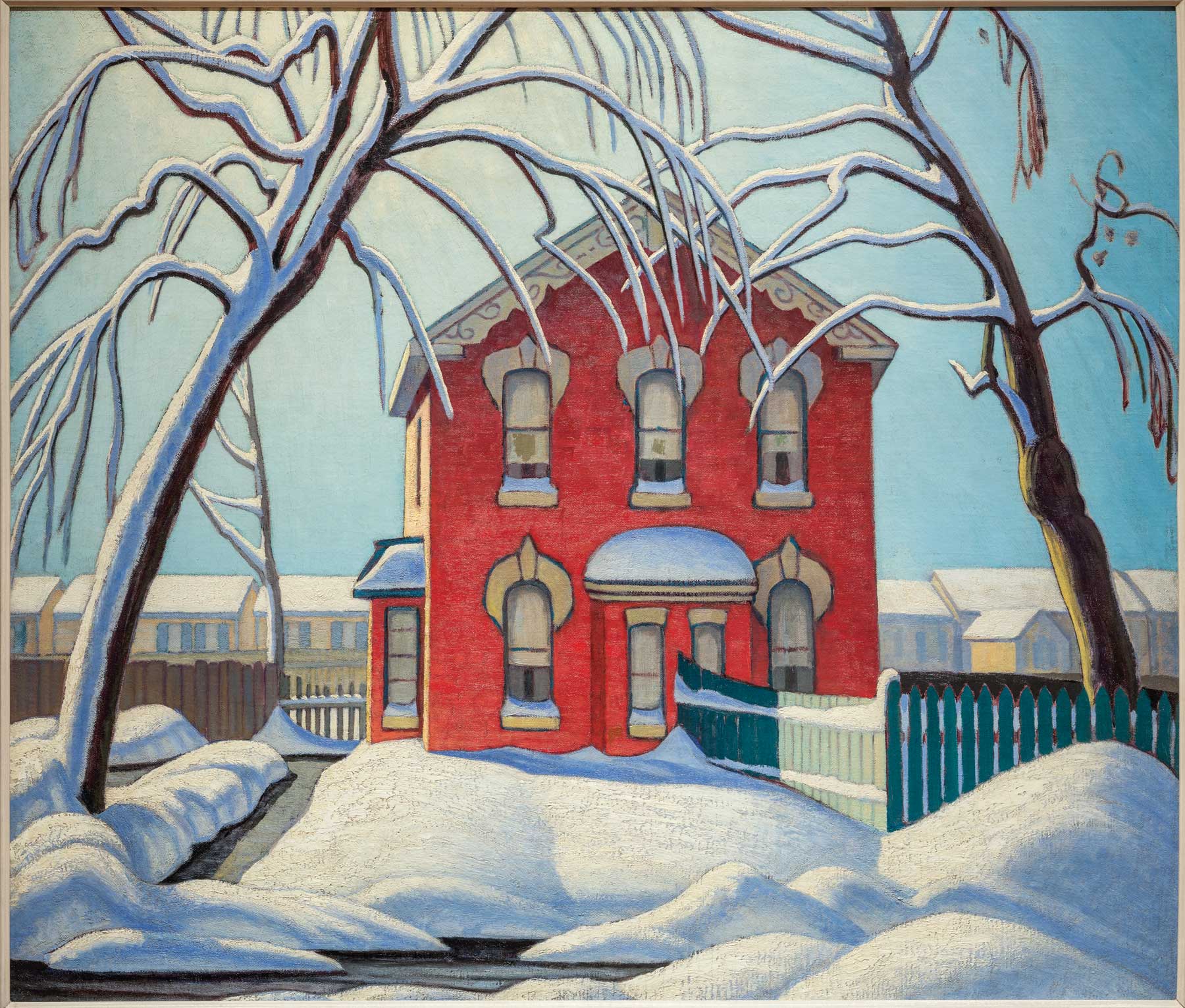
2. Lawren Harris: The Red House
oil on canvas, 1925

I love how the two trees frame the bright red house. The crisp white and blue create a fascinating contrast to the bright red of the house. While there seems to be no life in this picture, the branches of the trees make me think of long fingers pointing to the house. You can already notice Harris' increasing abstraction in this painting.

To see the image you can go to: http://gleanernews.ca/wp-content/uploads/2015/12/Page1.jpg


3. Lawren Harris: Snowfall
oil on canvas, 1920, 36 x 44 in

I saw this painting during the special exhibition “The Idea of North” at the Art Gallery of Ontario last summer. I love how Lawren Harris succeeds in creating a beautiful picture by wrapping the soft cover of snow around an old run-down house. His masterful use of complementary colours makes the image look bright despite the softly falling snow. The thick brushstrokes create a liveliness despite the fact that the house and street are deserted.

To see the image please go to: http://www.lochgallery.com/artwork/lawren-harris-snowfall.


4. Lawren Harris: Return from Church
oil on canvas, 101.8 x 122.3 cm, National Gallery of Canada

I am always intimidated by people in a landscape. I love how Lawren Harris uses simple shapes to give the illusion of people. The visible brushstrokes create a lot of energy in this otherwise calm painting. I admire his subtle use of bright red in some of the coats for added colour as well as his well planned use of complementary colours for the building.

To see the image please go to: http://www.gallery.ca/en/see/collections/artwork.php?mkey=2472


5. Lawren Harris: Old Houses, Toronto, Winter
oil, 1919. Art Gallery of Ontario, Toronto

I love how Lauren Harris uses complementary colours to create this bright painting of an old house that has seen better days.

To see the image please go to: http://canadianart.ca/reviews/lawren-harris-ago/. The image is part of the review.


6. Clarence Gagnon: Midnight Mass
oil on paper laid on wood, 1933, 18.8 x 22.7 cm, The Thomson Collection, Art Gallery of Ontario

I am fascinated by Gagnon's use of light to create mood in his painting “Midnight Mass”. I love the composition that is dominated by triangles, many of them pointing directly at the church.

To see the image you can go to: http://www.ago.net/agoid76671


7. Clarence Gagnon: After the Storm (Après la tempête)
ca. 1922, oil on panel, 6 1/4" x 9 1/4"

Again, I am fascinated by the play of light and shadow. The brightness of the painting reflects what I most love about the brisk winter days when the sun lets the snow sparkle and the light creates colourful shadows. The snow that is so thick, it is weighing down the fir trees. This is how I picture winter.

To see the image you can go to:
 http://cultured.com/image/1080/After_the_Storm/#.WK-Yq39ToVZ.


Claude Monet [Public domain], via Wikimedia Commons
8. Claude Monet: The Magpie
oil on canvas, 1868–1869, 89 cm × 130 cm (35 in × 51 in), Musée d'Orsay, Paris

Monet and fellow Impressionists painted the winter landscape to capture the natural effect of snow. The Magpie is one of more than 100 snowscapes produced by Monet. It is Monet's largest winter painting. A solitary black bird, a magpie, is perched on a gate as the light of the sun shines upon freshly fallen snow creating blue shadows. I just love the light in this picture and the blue of the shadows. The Impressionists were the first artists who used colour instead of black to suggest shadows making them look much more natural.


Franz Marc [Public domain], via Wikimedia Commons
9. Franz Marc: Dog Lying in the Snow
Oil on canvas, 1911, 62.5 × 105 cm, Städelscher Museums-Verein e.V., Frankfurt/Main

Franz Marc was convinced that animals were closer to God than human beings. He considered them purer in soul and therefore more beautiful. The dog lying in the snow seems to be in perfect harmony with its surroundings. When I look our pets, I have to agree with Marc's opinion. Our dog Alex and our cat Miko give us so much joy and unconditional love.


Paul Gauguin [Public domain], via Wikimedia Commons
10. Paul Gauguin, Breton Village in the Snow (Village breton sous la neige)
oil on canvas, 1894, 62 x 87 cm, Musée d'Orsay, Paris

Gauguin followed with this painting in the footsteps of many Impressionist painters who were fascinated by the effects the changing light and different weather conditions had on the snow-covered landscape. The painting shows a village seemingly drowning under the heavy snow. It is still undisturbed by traces of human life at the beginning of a new day. I love the simplified forms and visible brushstrokes.


I am sure that you are getting tired of all the snow we had over the last couple of weeks but it definitely makes the world look beautiful and bright. Hopefully, my blog is a nice farewell to the winter season. I am ready for warmer weather and the first signs of vegetation popping up between snow patches as harbingers of spring.

As March Break falls into next month, I dedicated next month’s blogs to experimenting with different gels and pastes. Some of the materials are not only great for artists but can be easily used with your children or grandchildren for some creative activities.

If you enjoy my blogs, please share them with family and friends. Thank you in advance for helping me to increase my audience.


Friday, 26 June 2015

Favourite Artists


Blog 25

When I wrote last week’s blog about Antoni Gaudí, I started thinking about the artists that have influenced me with regard to my painting style. A couple of names came to my mind, not all of them were famous artists. Some influences were more obvious than others.

All of my teachers have influenced me, along with my painting buddies. Being with them on painting trips and seeing first hand how they work certainly has an effect on my painting style. The agreement on a painting location can create a mutual influence. We look for a place that excites all of us. Sometimes, a choice might suddenly provide an image you would have missed on your own. I enjoy looking at the focus each of us picked for their painting. Sometimes, the the similarities are astonishing, other times everyone picked a different part of the scene in front of us. While witnessing each other’s struggles and successes as well as during the day’s reflection, you get new ideas and insights.

There are many examples in art history where painters have influenced each other to help each other grow. However, I don’t want to talk about my contemporaries today but about the masters who have inspired me. I have already mentioned Frida Kahlo and Emily Carr in one of my May posts. This time I am looking at the four other painters who have inspired me.

Waterlilies,  acrylic on canvas, 18" x 24"
First of all there is Claude Monet. I love the light and colours in his paintings. I admire that he painted the same subject over and over again to study the change in appearance at different times of the day and season. This is something that fascinates me whenever we return to Kamouraska. No matter how often I paint a certain scene, it always looks different due to the quickly changing light and the tides.

However, when I took a workshop on his way of painting, I realized that I did not enjoy his technique at all. I gained immense respect for his use of small, thin, yet visible brush strokes which give the illusion of movement, but had a hard time staying patient while using the short brush strokes. It was hard to put the colours next to each other without blending them.

Ottawa Valley, acrylic, 16|" x 20"
Then there is Vincent van Gogh. I just love his bright colours and the wild movement in his paintings. His strong brushstrokes let you feel the energy and passion van Gogh put into his paintings.You can feel the urge he had to express himself through his art. This is an energy I would like to put into my paintings because this energy is what the viewer feels when he looks at the finished painting.

The Front, acrylic on canvas, 22" x 28"
When I was introduced to Joseph Mallord William Turner, the “painter of light”, I was captivated by the luminosity of his skies. Since then the design of my skies became very important to me. I particularly enjoy his technique of painting layers over layers with very loose brush strokes creating lots of movement. His technique is especially useful whenever I only have short periods of painting time

The Red Tree, acrylic on board, 8" x 10"
Last but not least, there is Tom Thomson. When I paint outside with my painting buddy Janis, it takes me a lot longer than her to capture a scene. This is due to our different temperaments and painting styles. What I learned during a Tom Thomson workshop is that he used his time on site to capture the essence of the scene with quick thick
strokes. He did not aim for a finished painting. If he liked a certain scene, he went back to his studio and painted it on a larger canvas. This was a big revelation for me, one I have to remember constantly. It is easy to forget sticking to the essence when you are confronted with an overload of impressions. I love the energy that is captured especially in his sketches with the help of bright colours, and thick brush strokes which express movement.

Even though the four painters have different painting styles, they all managed successfully to capture the essence of a scene and the energy of the moment. They completely immersed themselves in the process of painting so that you can feel the physical sensation they felt when they painted their pieces. This is something I aim for: to be fully in the moment, to simplify a scene to keep the focus on the things that are important. An image is so much more powerful when you keep the big picture in mind by eliminating the small and unimportant stuff.

I am always open to learn something new. Incorporating new techniques or materials into my art helps me to grow and hopefully keeps my art from growing stale. It is a life-long process and I am excited about new possibilities and challenges.

If you enjoyed this blog and would like to get more information about my art, I encourage you to sign up to my monthly newsletter on my website www.KerstinPeters.ca. The newsletter is published on the last Wednesday of every month. When subscribing, you will automatically receive my free eBook “I Am Ready To Paint But Where Do I Start?”.

If you know someone who might also like to read my blog, please share it. Thank you in advance for helping me to reach a bigger audience.