Dog

Dog

Friday, 9 October 2015

Plein Air Ensemble Fall 2015 Painting Trip, Part 1


Blog 40

This is part 1 of my travelogue of the Plein Air Ensemble trip to Lake Clear in Eganville.


Friday, October 2, 2015

Right now we are in the area of Lake Clear in Eganville where the Plein Air Ensemble is spending the next couple of days. Hélène, Janis, and I arrived yesterday to get everything organized for the arrival of the rest of the group. We still found time to paint.

The colours are not as intense this fall. Many of the trees are just too dry and the leaves just turn yellowish brown. However, there are pocketful of really beautiful colours. The reds and oranges bring a lot of vibrancy into the green landscape.
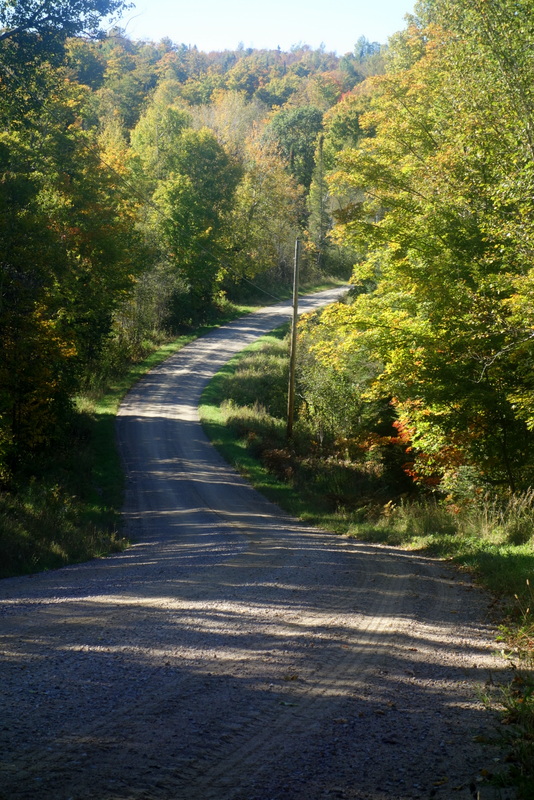
After driving around a little bit to check out the area, we ended up at the historic stone fence which was erected by hand by the German immigrant Carl Ludwig Neumann. We stayed there to paint. I decided to paint the curving road. After having spent the summer finishing up paintings, and not having painted “en plein air” since May, it was quite a challenge.

In the evening, we met up with Charlie and Mike who also had arrived a day early. We drove together to downtown Eganville to meet our friends Sharon and Bill who moved to the area a couple of years ago. We had a great German dinner at “The Granary”. The schnitzel were really good and the dessert was just amazing. It took three people to finish our crepe Denmark.

Back in our cottage, Janis, Hélène and I played a game of “Paquet”, where Janis did not give us a chance.

Right now, we are on our way to the store to get the groceries for the daily “Happy Hour” when all the artists get together before dinner. In the afternoon, we will be going out to paint.
__________


It is nighttime by now, and I should be getting ready for bed. I am too worked up to sleep even though I am tired.

  
We had another very windy day, but we found a beautiful vista in Cormac. I managed to finish a small painting and got a good start on a second painting before we had to head back.

At 5 pm, we met everyone at “Happy Hour” for a presentation by Christine, the former owner of Opeongo Mountain Resort and now full-time artist. She and our painting buddy Kathy had put a lot of work into marking maps with interesting painting sites, and giving us information on picturesque spots.

The evening held a couple of excitements. First, one of the cottage doors did not open even though the electric lock opened. Luckily, the resort owner was still on site and able to help.

Then, Janis, Hélène, and I were waiting for the return of one of our participants while trying to distract ourselves by playing cards. She had left her purse at an Ottawa gas station and gone back to get it. However, we were worried whether she would find the resort again in the darkness. Once four hours had passed, we got more and more worried with every minute that passed. After more than 5 hours and repeated checks at her cottage, we were ready to call the police. Right at that moment, she arrived. We were too relieved to be angry at that point. As organizers you just feel responsible for everyone’s safety. Starting tomorrow there will be a new rule: Everyone running unexpectedly late has to inform us. There is always the possibility that someone loses track of time or gets lost, which is not a problem as long as we know what is going on.

On the bright side, we saw a beautiful yellow moon over the lake and a sky full of stars. I am sure a beautiful day lies ahead of us.

***

I hope you enjoyed my travelogue and the photos of the beautiful region so close to Ottawa. There is a lot more to come. To read more about the painting trip, please return to my blog next week.


Friday, 2 October 2015

Maquerade


  Blog 39


As October is generally associated with Halloween, it seemed appropriate to tell you the story behind my painting “Masquerade”.

When Arteast Ottawa picked the theme “A Night at the Theatre” for their 2011 exhibition at the Trinity Gallery at the Shenkman Arts Centre, I was initially thinking about ballet dancers or wealthy ladies and gentlemen in fancy outfits in their boxes, the way you see them in movies. Then, I remembered the last Halloween outfit I wore. I am not a big Halloween fan but each year when we went out with our kids to go trick-or-treating the neighbourhood for treats, I dressed up a little bit. I knew how much my kids liked it, and that made it fun. That particular Halloween, I did not feel like dressing up at all, so I had just grabbed a cheap face mask with feathers, my gold shimmering winter coat, and an antique fox scarf. I looked very elegant that night.

I used one of the pictures we had taken as the reference photo, hung up the mask and fox scarf in my studio and started painting. While I had started a portrait of myself many years ago during a workshop, I am not to keen on painting myself. However, this was different as part of my face was covered by the mask. I liked this touch of mystery.

As I had anticipated, the details of the face were still the most challenging part, despite the fact that a big part was hidden behind the mask. But my eyes and mouths were visible. I was not satisfied with the detail I got from the photograph, and worked at times with a mirror, letting my eyes wander from photo to mirror to canvas and back.

I am quite happy with the result. "A Night at the Theatre" is all about diving into an imaginary world and playing roles. What better way than to paint a self portrait hiding my face behind a mask. The face and therefore the person's identity are hidden. Feelings and facial expressions are not visible. Everything is mysterious and open for interpretation.

It also reminds me of the fact that we often hide behind an invisible masque because we are afraid to show ourselves to others out of fear of rejection.

There is a long history of famous artists capturing their faces in self-portraits. What has fascinated so many to create their self-portraits?

A lot of artists used models for their paintings. However, as most artists did not make a lot of money, posing for themselves was a cheap and always available alternative. Before the invention of photography, it was the only way to capture the appearance of a person. The self-portraits would, however, often not only show physical attributes but also give you a glimpse behind the facade. The artists would present themselves in their profession, show their experiences and struggles in life, their character traits, their social status, and their style. For example, Frida Kahlo’s and Vincent van Gogh’s self-portraits let you step into their world of pain and struggle, of fight and despair. Self-portraits give the artists a way for self-investigation without restrictions and expectations from the establishment. They leave a very intimate personal legacy, an image that will outlive the artist and create immortality. Self-portraits also served as advertisement. They were an excellent tool to advertise the artists’ skills to potential customers.

Have you ever done a self-portrait or thought about having a portrait of yourself painted? Why? What intrigues you about a self-portrait or portrait?


Friday, 25 September 2015

Common Art Myths - Part 2

 Blog 38

Beckett's Creek - Summer, acrylic, 11" x 14"

Fall at Beckett's Creek, mixed media, 30" x 40"


I hope you enjoyed last week’s blog. This time, I would like to share the second part of the ten art myths with you.


6. Painting on Small Supports is Easier than Painting on Big Supports

An artist usually picks the size of his support (the material or surface onto which the paint is applied, e. g. canvas, board, paper) according to the subject he wants to paint and effects he wants to create. The bigger the canvas the more impact it will have on a wall but there will also be more restrictions to where it can be hung.

Picking the size of a canvas also depends on the painting location. In the studio, the artist is usually more flexible than outside. The transportation to the painting site has to be considered as well as the practicality of putting up a big canvas when painting in nature. The bigger the canvas, the heavier it is and the easier it can be blown off the easel (or blown away with the easel) on a windy day.

Usually, if you have a smaller canvas you just adjust the size of your brushes accordingly. However, I find extremely small canvases often a bigger challenge because you have to really simplify or you will have paint so tiny shapes which require a steady hand.

The size of the canvas definitely does not correlate with the time needed to finish a painting. Sometimes you get just stuck at a certain point and it is a challenge to get the painting right. This can happen to you no matter the size or subject. 
 
7. You have to Follow the Rules

While there are a couple of rules to help artists to make a composition more interesting and to create the illusion of space, there are many examples where artists have successfully broken the rules. Canadian painter Alex Colville is a good example of someone who broke many rules purposefully, but made sure his compositions were still convincing. For example, his subjects cast no shadows, they leave no trace or footsteps and seem to float.
Plein air painters might also have faced the following situation: The painting spot is clouded over while the sun is lighting up a field in the distance making it look warmer. While you usually should use warm colours in the foreground as they seem to advance towards the viewer and cool colours in the background because they give the illusion that something recedes, this is not what they are seeing at that moment. Therefore, if they want to capture the scenery in front of them, they will put warm colours in the area that is highlighted by the light.

If you want to create a lasting quality piece of artwork, you have to follow some rules dedicated by the medium you are using. For example, you should not mix acrylic and oil colours if you want to make sure that the surface is sticking to your canvas and not cracking. However, there are artists who know about the risks and do not care about the consequences for their art because their aim is not to create something that is lasting.

8. A Colour is Either Warm or Cold

This is what many students learn when they first study colour theory. There are the primary colours red, yellow and blue, and secondary colours green, purple, and orange. It is a simplified approach. However, let us take for example red and green. Red is generally a warmer colour than green. However, when you add blue to the red to make it darker and yellow to the green to achieve a yellowish green, the green is suddenly warmer than the red. Moreover, you also have to take in consideration that the temperature of any colour is always influenced by the surrounding colours. While green seems cool compared to yellow, it will look warm when placed next to blue.

9. Adding White to a Colour Lightens the Colour

This is partially true. The process of adding white to a colour is called tinting. However, when you add white (especially opaque paint like titanium white), you not only lighten the colour but also make the colour look chalky by removing the vibrancy of the colour. Tinting a transparent color with titanium white will produce an opaque colour. You will also change the temperature of the colour, making it cooler. In the case of red you even end up with a different colour: pink. If you just want to lighten a colour, mix it with a lighter version of the original colour or add a small amount of light yellow.

10. Good Artists Work with a Limited Palette of Colours

The number of paints on your palette does not automatically say something about the skills of you as an artist. However, many artists decide on a limited palette for the following reasons. Even though you can buy about 100 different colours right out of the tube, buying a huge quantity of colours is not only expensive, hard to keep organized, but also too big a weight to carry along, if you work at different locations. With just a basic palette you can mix so many different variations of colours. Preparing a couple of mixing charts will make it faster to find the right combination, especially if you are not an avid painter. For the above reasons, many artists work with a limited palette. I use the following pallette:

Lemon yellow
Cadmium yellow medium
Cadmium red
Alizarin crimson permanent
Ultramarine blue
Cobalt blue
Titanium white
Burnt Umber
Sap Green
Payne’s Gray

However, there are some colours that I use on special occasions because I just found that I have not managed to create a certain vibrant colour I was looking for. One is magenta which I often use for painting flowers. Sometimes, I just see a beautiful colour and add it to my palette for certain subjects.


I hope you liked the blogs about the art myths. I am sure there are many more. Please sign up at the bottom of this page, if you would like to receive my blogs automatically by email.


Friday, 18 September 2015

10 Common Art Myths - Part 1


 Blog 37

watercolour, 1995

This week, I would like to entertain you with some art myths I heard during my career as an artist and instructor. Maybe, some of you are considering taking a painting course this fall and are wondering whether they would have enough talent or would just embarrass themselves? While most of these art myths are written from the perspective of a painter, they can be easily translated into other arts. 


Malta, acrylic, about 2004


1. You Need Talent to be an Artist

During my time as an art instructor I have seen that everyone can paint. However, not everyone can paint like Monet or even the person beside them. If you look at art, you will see that there are so many different styles. You just have to find out your own style and the subjects that inspire you. It is great to look at other work and to admire and learn from it, but you are not the person who is sitting next to you. In every painting is a little bit of you ingrained. Your temperament will shine through your brushwork and the looseness of your paint application. Your mood will influence your choice of colours. If you have a group of students who paint the same scene you will not even get two paintings which look the same.

While it is true that some people have more inherent talent for art than others, everyone can learn the fundamental techniques of painting, for example the rules of an interesting composition, and colour mixing.

One of my early teachers once told me that the most important character tread to become a successful artist is not talent but perseverance. There are many talented artist who will never succeed because they are lacking persistence while others with less talent can succeed with hard work. Plus you need a certain amount of luck and to be a professional artist a good marketing strategy. It is not only about creating your art, you also have to sell it.

If you've worked at developing artistic skills, actively pursuing ideas rather than expecting creative thoughts to come to you, you're not at the whim of your so-called talent. You've already in the habit of exploring possibilities, of investigating, of pushing things one step further. You're set for the long term.
So instead of asking yourself if you have talent or not, grab a paintbrush if you feel like it. The most important part of painting is not the final painting but having fun creating and learning something new along the way.

2. Painting Should Come Easily

During one of my introductory painting classes, a student who was struggling noted that it must be nice that painting just came so easily to me. For a moment I was stunned. While successful painters might make it look easy to create a painting when you watch them during a demonstration, it has taken them their whole artistic life to get where they are, including many failed attempts and frustrating moments. Like any skill, it takes practice, practice and more practice to improve your techniques. With your increase in experience it will be easier to master some of your skills. For example, when I paint a lot, mixing certain colours comes easily. On the other hand when I have had a long break from painting, I feel really stiff trying to put my image on the canvas, just like after not having exercised for a while.

II you believe that painting should be easy, you will soon end up frustrated and disappointed. Painting will always be a challenge, because you are constantly striving to improve. If you get complacent with your painting skills, it becomes like painting by numbers. it loses its excitement. Painting is a lifelong learning experience, so the more skilful you become, the more you demand from yourself.

3. Every Painting Must be Perfect

If you expect every single one of your paintings to turn out perfectly, you will set yourself up for disappointment. You will tense up in the attempt to reach perfection instead of enjoying the process of creating. Looking at famous artists’ works, you will realize that not all of their paintings have been executed in the same successful way. Instead consider each painting as a new challenge, try some new techniques or materials, or change the subject.

As I do a lot of plein air paintings, I see them as a way of journaling. Some days, things just flow easily, and the scenery might just capture me, while on others the weather might not be favourable or I am not at my best.

In any case, Salvador Dali summed it up perfectly when he said "Have no fear of perfection, you'll never reach it".

4. Good Drawing Skills are the Basis of a Good Painting

While it can certainly is a plus to have good drawing skills, each medium requires its own set of skills. While some artists like to do detailed drawings of their subject before the paint the image on their canvas (or other surface), others just start out with a very rough sketch directly on the canvas. Some just build their composition on the go.
So if you think you cannot paint because you cannot even draw a straight line do not worry. Just pick up a brush and some paints and get started. You might surprise yourself. Almost all of my students are usually pleasantly surprised what they have achieved.

I draw a very rough sketch with a small brush on the painting ground when I paint outside. In the studio, I start with a rough pastel sketch blocking in the basic colours. Then, I go over the surface with a acrylic glazing medium to keep the pastels from lifting off my surface and blending the edges slightly. After this step, I start putting on my acrylic paints.

5. You Should Not Copy Another Artist’s Work

Studying the work of great artists by copying their paintings will help you to improve your own skills. You will also increase your appreciation of the artist’s skills because what often looks really easy proves to require a very solid knowledge of colour interactions and composition aside from the painting skills.

However, there is a difference between copying a masterpiece to study another artist’s process of creating and his techniques, and imitating other artists’ ideas and even passing them off as your own. You should always give credit to the original artist on your painting.


I hope this has encouraged you to accept the challenge to learn a new skill. If you have always postponed signing up for an art course, take the next step. Next or week, I have five more art myths that came to my mind. What art myths have you heard? What is your opinion on the points I have raised?